Remote work describes how a role is performed, but it does not answer where you may live, when you must work or how the employer would hire you. A useful search starts with the kind of work you can do and then checks these practical conditions. Keep an attractive work-from-home label separate from the evidence that the vacancy is suitable and genuine.
1. Identify work you can perform remotely
Start with actual duties rather than searching only for remote jobs. Customer support, bookkeeping, software development and project coordination all have different experience, equipment and communication requirements. A role's remote label does not make it entry-level.
List the tasks you have performed and the conditions you need to do them well. If you are moving into a new field, identify the training and evidence of skill you would need. Avoid buying a course solely because a message promises guaranteed remote employment afterwards. Ask what employers in the field actually request and compare several genuine adverts before deciding where to invest your preparation time.
2. Distinguish fully remote, hybrid and occasional flexibility
Read the workplace section and the duties, not only the title. Hybrid may mean several days in an office every week. A role advertised as remote can still require initial training on-site, periodic travel or attendance at customer locations.
Ask how often attendance is required, who pays travel costs and whether the arrangement is written into the relevant agreement. Check that the office is somewhere you could reasonably reach. If you can accept both local hybrid work and compatible fully remote work, describe them as alternatives in your request. Do not assume that an employer's registered office is where every employee must work.
3. Check where the employer can hire you
Many remote adverts restrict residence to a country or region. An employer may need a local entity, an employment arrangement or other processes before hiring someone living elsewhere. The word worldwide is not a substitute for confirmation that your situation is eligible.
State your country of residence in the search and ask which entity would employ you. Clarify whether the role is employment or self-employed contracting. For cross-border work, check the relevant official guidance on your circumstances before accepting. Location, tax, social-security and immigration questions should be resolved with competent authorities or advisers; a search result cannot answer them reliably for every individual.
4. Verify working hours and time zones
Find out which hours require live attendance and which tasks can be done asynchronously. A flexible role may still require daily meetings, customer coverage or a minimum overlap with another time zone. Check weekends, shifts and on-call duties as well as the headline weekly hours.
Write your own availability clearly, including any non-negotiable limits. Ask how changes in daylight-saving time affect recurring meetings if the teams are in different regions. Compare the employer's expectations with your home responsibilities and working environment. A remote job that requires regular night work may not fit someone looking for daytime flexibility, even if the commute is zero.
5. Check equipment, expenses and support
Ask what equipment is supplied, which software you need and how access is set up. Clarify the process for technical support and any agreed reimbursement. Never send a verification code or install an unknown remote-control tool merely because someone claims to be onboarding you.
Requests to pay a recruiter for equipment, return money from a cheque or deposit funds to unlock tasks are warning signs identified by consumer-protection authorities. Independently verify the employer and its instructions before any payment or sharing sensitive information. A believable logo or interview is not enough to establish authenticity; legitimate details can be copied into a fraudulent message.
Official references: FTC
6. Compare the actual offer
Review duties, expected output, pay, currency, hours, holidays and contract type. Check how performance is assessed and how you will communicate with colleagues. Ask who manages the role and what a normal first month looks like.
Keep the answer in writing where practical. Distinguish a vacancy description from a formal offer and a formal offer from a signed agreement. If important terms change during the process, revisit your decision. Do not assume that remote employment automatically means choosing your own hours, working from any country or receiving the same benefits as another employee in a different legal arrangement.
7. Use a structured screening checklist
For each advert, record the original link, employer, duties, allowed residence, office visits, schedule and contract. Mark unclear items as questions, not as positive matches. Verify that the vacancy is still open and that the application page belongs to the employer or an identified recruiter.
Prioritize opportunities that satisfy your essential conditions and have enough information to assess. If a role looks interesting but location or hours are unknown, ask a concise question through a verified channel. Keep a dated note of the response. This avoids applying repeatedly to the same offer through different boards and makes it easier to notice contradictory descriptions.
8. Make your request specific
Combine the role and relevant experience with remote conditions: country of residence, working languages, hours and acceptable travel. If hybrid is acceptable only near your home, keep that limit explicit. Use a broad sector preference only when you are genuinely flexible about the work.
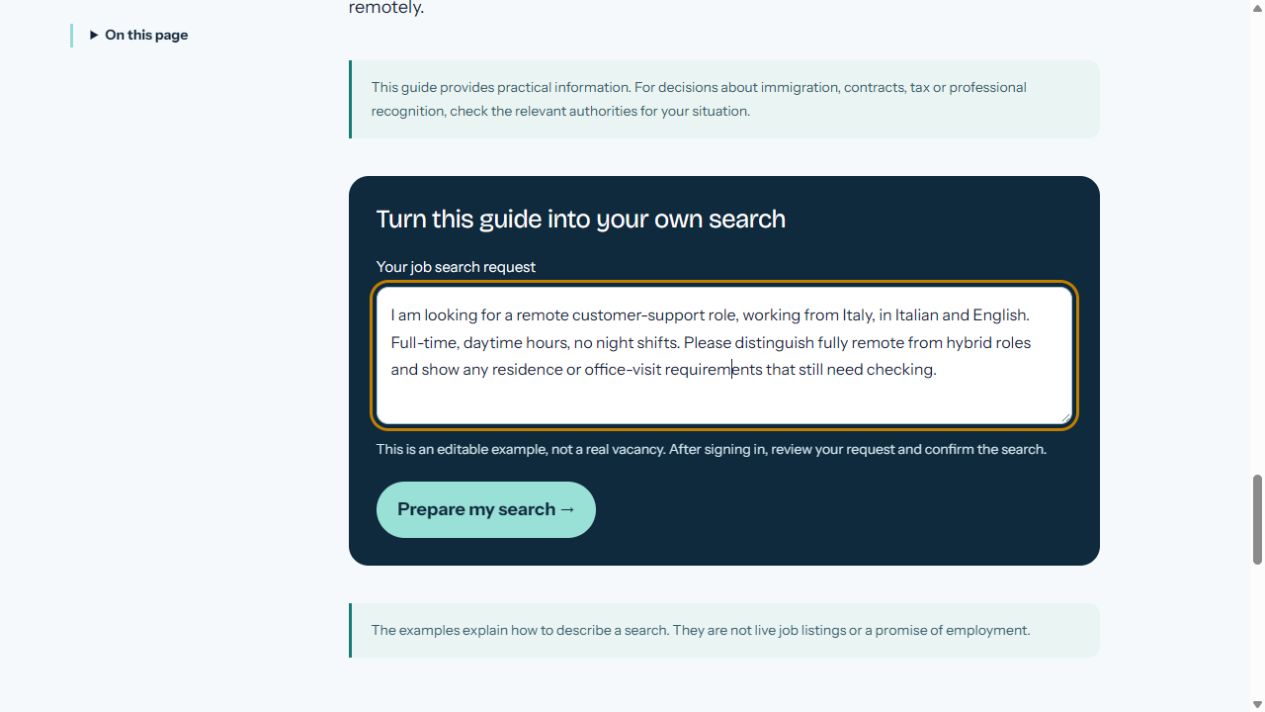
SayMyJob can help organize the search and evaluate information from available sources, but it does not certify an advert or guarantee complete coverage. Results can be partial while evaluation continues. Review each original offer and decide whether to apply yourself. The example below is a request you can edit; it is not proof that an employer can hire you remotely.
This guide provides practical information. For decisions about immigration, contracts, tax or professional recognition, check the relevant authorities for your situation.
Turn this guide into your own search
The examples explain how to describe a search. They are not live job listings or a promise of employment.