AI can make a job search easier to structure, especially when your experience does not fit one familiar job title. It can also produce confident but incomplete answers. A useful method gives it a clear task and leaves the important decisions with you: what work you want, which conditions you can accept and whether an employer's offer is real. Start with a small, repeatable process rather than asking for the perfect job in one message.
1. Turn your experience into duties
List what you actually do before choosing job titles: reconcile invoices, answer customers, prepare reports, maintain equipment or coordinate a team. Then identify two or three titles employers might use for those duties. A small business may call a role administrative assistant while a larger one uses accounts assistant. Similar titles can also hide different work.
Ask AI to explain possible title variations and the differences between them. Treat the suggestions as search vocabulary, not evidence that you already have the skills for every suggested role. Keep your own list of tasks and examples of experience. That list helps you assess a vacancy whose title sounds suitable but whose duties do not.
2. Separate essentials from preferences
A useful request distinguishes conditions you cannot change from things you would like. For example, 20 hours a week may be essential because of caring responsibilities, while the sector is flexible. Location, travel, shift work, contract type and language requirements can all matter more than a fashionable job title.
Write essential conditions explicitly. If you accept alternatives, describe them separately: on-site within a stated area, or fully remote where the employer can hire someone living in your country. Avoid contradictory wording such as fully remote with daily office attendance. If you do not know your salary threshold or preferred sector yet, say so rather than inventing a precise number.
3. Give the assistant one task at a time
Start with a request to organize your criteria. Next ask it to explain one vacancy or compare a short list. Mixing career advice, immigration rules, salary expectations and an application letter in one long request makes it harder to notice an error.
Useful instructions include: separate stated facts from unknowns; quote the relevant part of the vacancy briefly; identify questions to ask the employer; and do not assume that a missing requirement is satisfied. You can request a table of duties, location, hours and open questions. Keep the original text beside the answer so you can check that the explanation follows the advert.
4. Review the original vacancy
Read the employer's description before making a decision. A summary can miss a qualification, a probation period, occasional travel or a restriction on where remote staff may live. Check the publication or closing date and whether the original application page is still available.
Distinguish an advert's requirements from an AI assessment of your fit. A percentage, label or ranking is not an employer's approval. Mark each important condition as confirmed, incompatible or unknown, then decide which unknowns are worth asking about. If the original page contradicts the summary, use the original information and request a corrected explanation rather than accepting a reassuring answer.
5. Improve applications without inventing experience
AI can help make a paragraph clearer or identify which genuine experience is most relevant. Give it a factual outline and ask it to preserve dates, responsibilities and achievements. Review every number and claim before sending the document.
For example, describe that you prepared a weekly invoice report, not that you transformed the finance department unless you can substantiate that claim. Europass offers practical guidance on making a CV readable and tailored to the role. Choose evidence you can explain in an interview. An application written in polished language still needs to sound like you and accurately reflect what you have done.
Official references: Europass
6. Protect your information
A job search request usually needs criteria and a broad description of experience, not your home address, bank account, identity document or verification code. Remove other people's names and confidential employer information from examples you give to an assistant.
Before uploading a CV to any service, read how it uses and retains information and whether the upload is necessary for the task. Use placeholders when drafting sensitive messages. Review links independently instead of following an unfamiliar payment or login page suggested by a message. Do not treat a professional-looking AI-written advert as proof that the recruiter or employer is genuine.
7. Change one criterion and compare
If the results are not useful, identify the reason before broadening everything. Are the duties wrong, the commute unrealistic or the working hours incompatible? Try one deliberate change, such as adding an equivalent role title or widening the area within a limit you can accept.
Keep a short record of the original request, the changed condition and what improved. Do not drop a genuine requirement just to produce a longer list. A few well-understood opportunities can be more useful than many incompatible adverts. If information is missing, ask for it to be marked as unknown; a guessed answer does not resolve the problem.
8. Use SayMyJob as a starting point
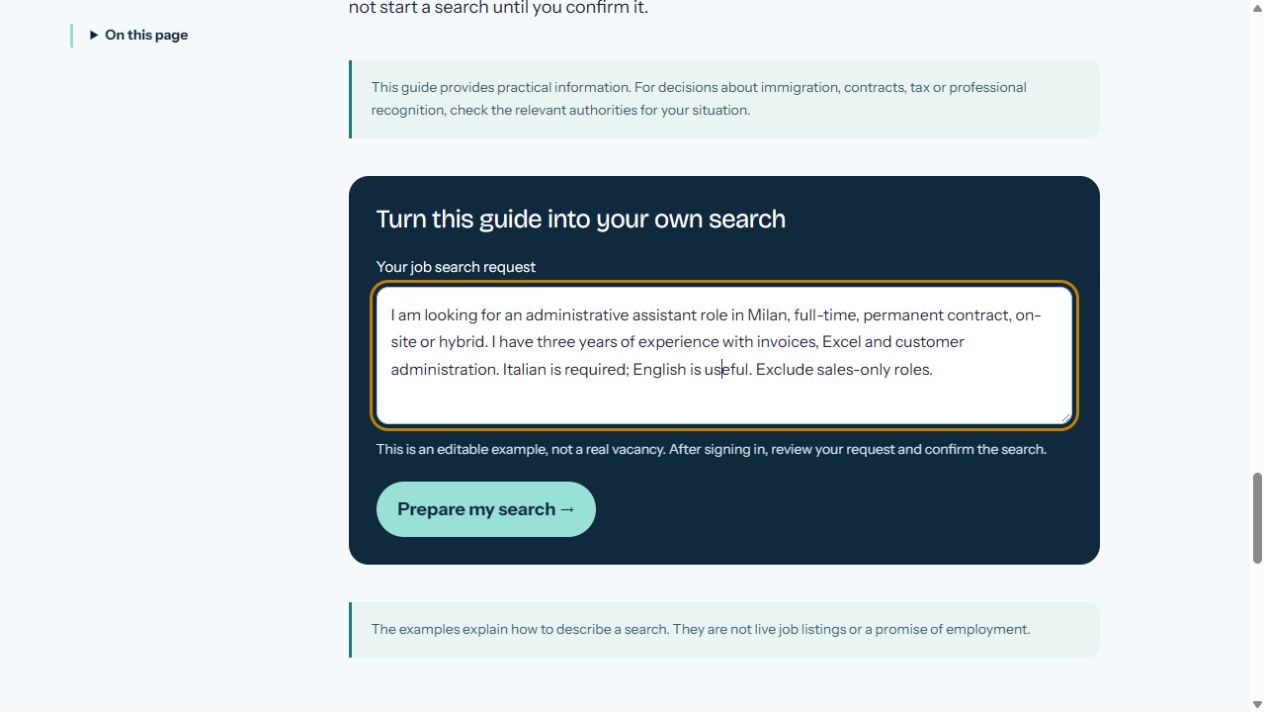
On SayMyJob, you can prepare a request in your own words and continue in your personal area after registration. Include duties, place, hours and acceptable alternatives. Review the request before confirming a search, and keep essential conditions visible.
Results depend on the available sources and information, and evaluation may take time. SayMyJob does not promise complete coverage, an interview or a job. Use its assessments to decide what to inspect, then verify the employer and follow the original application process yourself. The editable example below shows a request structure; it is not a vacancy and does not start a search until you confirm it.
This guide provides practical information. For decisions about immigration, contracts, tax or professional recognition, check the relevant authorities for your situation.
Turn this guide into your own search
The examples explain how to describe a search. They are not live job listings or a promise of employment.